

Welcome to recreational soccer
The basic Cal North Recreational Playing League is classified as a non-competitive playing league within Cal North. This league is composed of teams that normally play within the boundaries of the league.
 The emphasis for the recreational playing leagues is for fun and ensuring that players get ample opportunity to have field playing time. Some leagues have policies which state that a player must play at least fifty percent (50%) of each game. This policy is totally league driven and league dependent. Players learn soccer skills as they proceed through their age groups.
Educate Yourself On Soccer
If you are new to soccer, or even if you have experienced soccer in the past, you can help yourself and your player by being familiar with the dynamics of soccer.
The document below was created by U.S. Youth Soccer to help parents understand and navigate through soccer. Take a moment to read through the document.
OFFSIDE
One of the fundamental rules is ‘offside‘. Some folks may say ‘offsides’, but there is no ‘offsides‘ the rule is properly called ‘offside’. Spectators may hear a coach tell their players to stay ‘onside‘. This practically means that the coach does not want a player in an ‘offside’ position, and hence tells the player to remain ‘onside’, so that they do not violate the ‘offside’ rule.
Staying ‘onside’ requires an attacking player to not be closer to the opponents goal than the 2nd to last defender, with the goal keeper counting as the first defender. This practically means that an attacking player may not be closer to the opponents goal than the goalkeeper and one defending player. The assistant referee on the sideline must have a direct, straight, viewing angle of the 2nd to last defender and any opponent. This angle is crucial to determine if an attacker is either event with the 2nd to last defender, or that they are past the 2nd to last defender and closer to the goal. One very key item needs to be mentioned; A PLAYER MAY BE STANDING IN AN OFFSIDE POSITION, BUT WILL NOT BE CALLED OFFSIDE UNLESS THEY ARE ATTEMPTING TO PLAY THE BALL, OR ATTEMPTING TO DISTRACT A DEFENDER/GOALIE. Just being in an offside position is otherwise NOT called. There are several other nuances that are attached to determining offside, which a referee has to recognize. The following video will show you the basic version of what offside is.
HANDBALL
A hand ball is another type of foul that coaches/spectators key in on. It’s obvious, a ball hits a hand/arm, and it needs to be immediately called a foul, right?–WRONG!
There are many facets to a hand ball foul calling by a referee, and the vast majority of coaches/spectators are not versed in the total package of circumstances surrounding the calling of a hand ball foul. There are many factors built into the proper calling of a hand ball call, which a coach/spectator are not aware of. There has also been a continuous ‘clarification’ of hand ball scenarios issued by IFAB over several years, which the coach/spectator would not be aware of. The hand ball rule has ‘morphed’ over the years. The following video will present a basic understanding of the hand ball rule.
SHOULDER CHARGE
A ‘shoulder charge’ is a legitimate soccer practice. It also may be known as ‘shoulder tackling‘. It’s purpose is for challenging for the ball. A parent of a U8 player, who has just moved up to the U10 age group will see this happening, and possibly consider it as a ‘foul’. Younger players, having just entering the age group, are more susceptible to a shoulder charge, as they are not used to it. They may easily ‘give up the ball’, or may fall, due to the shoulder charge contact. They are simply not used to dealing with it. It is a ‘tool’ that they get used to, while continuing to play, and will eventually use themselves.
The act of charging an opponent can be performed without it being called as a foul. Although the fair charge is commonly defined as “shoulder to shoulder” and without the use of arms or elbows, this is not a requirement and, at certain age levels where heights may vary greatly, may not even be possible. Furthermore, under many circumstances, a charge may often result in the player against whom it is placed falling to the ground (a consequence, as before, of players differing in weight or strength).
The Law does require that the charge be directed toward the area of the shoulder and not toward the center of the opponent’s back (the spinal area): in such a case, the referee should recognize that such a charge is at minimum reckless and potentially even violent.
A player attempting a shoulder charge cannot run across the field and hit the player, shoulder to shoulder, this would be a use of ‘excessive force’, which typically would cause the hit player to fall to the ground. A foul would be called for this type of ‘charge’.
While attempting a should charge, a player must keep their arm at their side and may not push out with their arm against the opponent. This would be considered a foul for ‘shoving’. Shoulder charging is a skill and needs to be practiced just like other soccer skills. 
CRITICAL ISSUES FOR YOUTH SOCCER, COACH & REFEREE RETENTION
There is a continuing issue of losses of both coaches & referees in youth soccer, with the referee shortages being the most critical. With a shortage of referees, games have to be canceled, existing referees are put under more stress (which could lead to them leaving, due to the stress), and players might not get to enjoy their games well, due to lack of needed referee availability. Having the proper number of trained referee crew members available for a game ensures the safety of the game and the fun of playing the game for players.
Coaches & referees are also affected by the demeanor of the spectators present. Dissent toward referees has been on the rise, even before Covid-19. There have been more and more incidents of heavy dissent directed toward referees, and physical violence. Coaches have also had part of this directed toward them, but the referees have caught the brunt of it. The coaches also have been having to deal with parents, who want to coach their players, during the game, over-riding what the coach wants the player to do.
Coaches & referees have increasingly shown that they have gotten tired of the ‘status quo’ in the behavior of parents at games. The parents have even gone after parents/players of the opposing teams, increasing a toxic environment at the games.
Some coaches & parents have the mistaken belief that it is ‘part of the game’ to heckle referees & coaches. This has no place in youth sports, as it dilutes the ‘fun’ aspect of youth sports. The yelling/screaming dissent activities should remain at professional sport activities that a parent attends, where it is considered to be slightly more of the ‘norm’.
US Soccer has made available a document, which all parents should read, on how they should interact with their coach. They should fully understand the concept of no coach, no team, which has happened to many players & parents. A coach is the initial, valuable resource that is needed, for a team to exist. This document is available here . As for both coaches & referees, parents must either learn to watch, and give positive commentary at games, or to basically keep their mouths shut. If they want to relieve pressure from their everyday life, by loudly venting dissent at a game, as a ‘social norm’, they need to find professional games to attend. This will help keep coaches & referees. The parents also need to understand that if they feel their child is a ‘star’, and needs to always be on the field, that other parents feel the same way about their child. Soccer is a ‘team’ sport, not a ‘me’ sport.

Players are placed into ‘Age Groups’, using their birth date as a criteria. Common age groups are:
U6 U8 U9 U10 U11 U12 U13 U14 U15 U16 U17 U18 U19
Age groups may be combined in some leagues, to ensure that there are enough players to form a reasonable playing bracket. This is very common in the age groups after the U14 age group. There is typically a shortage of older players.

Typically league registrations for play in the fall (play starting typically in August) often take place in the Feb.-April time frame, depending on the league. Some leagues have spring playing leagues and registration for these leagues could start in late December/early January. You would need to check with the league that you are interested in, as for their actual seasonal registration dates. Are you restricted to playing in a league in your city, where you live? No, you are not. If you do not mind driving for practices and games, you play sign-up to play in a city different than your own.
Some leagues have co-ed play and others do not for spring season. Most of the teams for fall play are established by gender, unless it is a small league, where they may combine genders, to insure enough playing teams.
Please note, you are not limited to signing up to play in just your city. If there is a league in another city, and you are willing to drive, you may sign-up to play there. This would also mean though that you would have to drive to weekly team practices in that city. For the recreational league, they play only in their own city and do not travel to other cities. The exception is for smaller leagues, in small cities, who may join play with a ‘next door’ league, due to a smaller selection of players to make teams.
The construction of teams from the pool of registered recreational players is a league dependent item. For information as to how a league constructs their teams, you need to speak with a board member from the league. Each league may have a different method of placing player on teams, and regulating such items as the following:
-
- Can a player select a coach or team to play for.
-
- Does a team remain ‘intact’, returning to play as is, for the next season.
-
- The process for not wanting to play for a particular team/coach.
-
- Any ‘special circumstance’, such as two players wanting to be on the same team, for ‘transportation’, or ‘practice/game’ reasons.
Spring league teams work with a generally lower percentage of recreational players. In some cases, age groups may be combined so that there is a reasonable range of teams for playing against each other. When this is done, you will have younger players mixed in with older players. This scenario may also include male/female players being placed on ‘co-ed’ teams. This is all driven by the total number of players registered for the spring season.
What Can A Recreational Team Provide To A Player
- Fun
- Comradeship
- Unity
- Opportunity to learn soccer skills in low-pressure environment
- Desire To Improve
- Team ‘identity’
There are factors relating to why children continue to play, and as to why they no longer want to play, which is best described here .
Making the Transition from Recreational to Travel Soccer
Evaluating Readiness for the Step Up to Travel Soccer
Has your player determined that they like playing recreational soccer, but they want more competition during play, and have dreams of playing high school/college soccer? To do either of these, they need to develop a higher/competitive mannerism of playing, which is learned by playing on a competitive soccer team. They have to be prepared for a change in playing style though. Being on a competitive team does not guarantee you 50% playing time, as exists on a recreational team. The team plays those that the coach feels can help them win the game, at the time. Players with higher soccer skills will typically get more playing time, while those players needing to learn more skills are subbed in/out more frequently. Competitive teams will also use more family time resources, due to games being played out of town and possibly more than one practice session during the week. The financial costs are also higher on a competitive team, due to traveling costs of gasoline/food, when needed. If the team goes to ‘away’ tournaments, cost for lodging will be incurred.
Moving up from recreational soccer to travel soccer hinges on the player’s readiness, which can be determined by a few key signs. These signs include the player’s passion for the game, their willingness to show commitment, and their existing ability level. If a player displays an intense desire to experience a more challenging level of soccer, exhibits a readiness to devote time for extra practice, and has a demonstrable skill level, then they could be ripe for the transition to travel soccer. Furthermore, a solid grasp of the fundamental rules and tactics of soccer is essential for navigating the more competitive landscape of travel soccer.


If you want to have some fun, and enjoy watching players have fun, watch the entry-level age group games (U5, U6, etc.). For a new coach, with no experience, this is a great place to start your soccer career. There are minimum expectations, with the greatest emphasis on the players having fun on the field. Full disclosure is needed here. You must also be prepared to handle your parents, which at times for coaches can add a degree of anxiety. Some parents may exhibit at games that they know more than you do, by constantly shouting out to their child on what they should be doing. This may not match what you, as the coach, have told them to do. This puts a player in a bind. Who do they then listen to, their coach, or their parent, who they have to live with every day.
As a coach progresses through the age groups they are expected to take coaching license classes, which gives the knowledge needed to pass onto players. The lower age groups generally require at least an ‘F’ license. Check with your league for their coach license policy and classes offered. Practice sessions during a week or for your team to learn soccer skills, and as a coach, you need to be able to teach them those skills.
With a coach license in hand, the next item that you will need to learn about are the league rules regarding age group play, Cal North Modified Rules for U10 play, and the FIFA Laws of the Game. Check with your league for information on these items.

You can find a league near you by using the new Cal North league search tool. You may find the new tool here.
Parent Web Resources
Basic Soccer Information
Basic Soccer Information For Parents (new to the sport, this is for you!)
Recreational Soccer Jargon
The Ten Commandments of a Soccer Parent
Soccer Rules
A Guide To The Game Of Soccer
Soccer Rules Of The Game For Baffled Parents
Soccer Safety
Youth Soccer Safety
Heat And Soccer Players
US Soccer
Player Development Initiative (PDI)
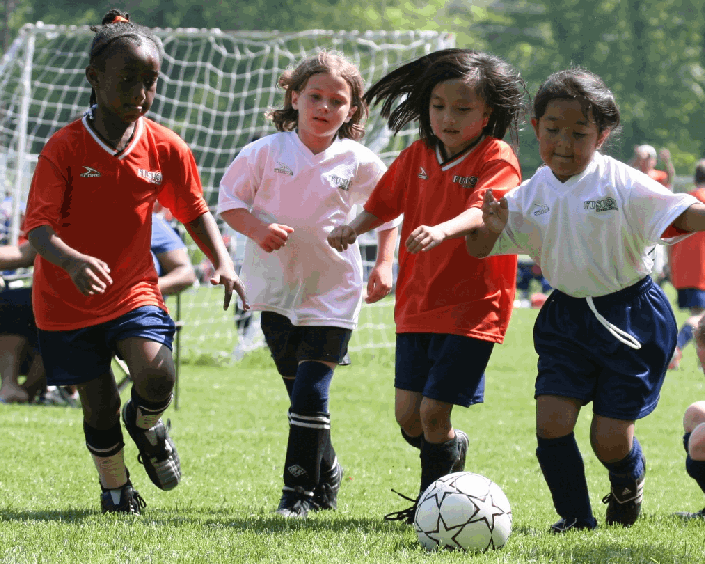
US Soccer has issued the Player Development Initiative for soccer playing/skill learning for young soccer players, which has new playing rules. These new rules are designed to ensure that youth players get frequent play on the ball, by having fewer players on the field of play. This ensures that the players are more involved in play. This helps to focus on their soccer playing skills, and their enjoyment of being directly involved in play. This new initiative covered the U6-U12 age groups. You may find US Soccer information on the Player Development Initiative HERE .

US Soccer PDI Versions ( Oct., 2017 )
Player Development Initiative 
Player Development Initiative FAQ’s
NOTE: The original PDI playing rules, for U10 play, using the buildout line, have now been modified to match the 2019-2020 IFAB playing rules for a goal kick. This change now allows players to cross the buildout line as soon as the ball is kicked. They do not have to wait until the ball clears the penalty area.
US Youth Soccer Small Sided Game Manual
My Summarized US Soccer PDI Versions
Small Sided Games Concept
Small sided games have existed in non-US based soccer play for years. The concept is part of FIFA’s ‘grassroots‘ campaign for soccer play, and is well established in many countries. FIFA states the following, for the emphasis on small sided games:
-
- you come into contact with the ball more often
-
- you experience a wider range of football situations.
-
- you can play in the attacking and defensive positions.
-
- you can take more strategic decisions.
-
- you have more opportunities to score.
-
- you can really improve your football techniques.
- it is more fun playing in a less stressful environment
FIFA states that in small sided games, “The children are also much more involved in the game (more movement and practice) and enjoy it much more than playing on a large pitch. Fewer players on the pitch and smaller teams ensure that each participant gets more individual attention. There are also more goalscoring opportunies (which is what children want) ….”. FIFA has a ‘Grassroots Festival‘, for emphasizing the Small Sided games concept. US Soccer has small sided game resources here .
Small Sided Game Concept Within US
Player Development Initiative
Leagues began implementing these plans as of August, 2016. As of fall, 2017, the rules become mandatory for all associated leagues.
Coaches will have to develop practice session scenarios to match the smaller player numbers on the fields. Changes in the U9-U10 age groups, affecting field design, will require changes in how players are taught to play and playing habits.
The PDI also increases the half time from 5 min, to 10 min, for U9-U10 players. This will allow coaches to speak with their team concerning observed playing mechanics, to further enhance their playing capabilities.
The initiative also modified the play time for U6-U8’s. U6-U8’s play time is four halves, with a maximum of 10 min. per half, with a 5 min. break between half’s.
The following will provide information on the new US Soccer initiative for small sided games:
Why Small-Sided Games?
Small Sided Games Rules
The follow video gives an overview of small sided game theory:
Soccer Build Out Lines
U9-U10 Age Groups

The build out line, was introduced for usage under the PDI, for U9 & U10 team play. This is to help further the skill level of field players and reduce unnecessary game pressure on young goalies.
Build Out Lines Rules
- No Heading Allowed. If a header is done, the opponent is to awarded an indirect free kick. If the header was done in the penalty box, the ball is to be placed on the penalty box line close to where the header occurred.
- No punting allowed. If a goalkeeper punts the ball, an indirect free kick should be awarded to the opposing team from the spot of the offense. If the punt occurs within the goal area, the indirect free kick should be taken on the goal area line parallel to the goal line at the nearest point to where the infringement occurred.
- GOAL KICK. For a goal kick, all opponents must be behind the buildout line. When the ball has been kicked and moves, the opponents may cross the buildout line and attack the ball.
- Goal Keeper Save. On a goalkeeper save, all opponents must move behind the buildout line. Can a goalie do a quick release of the ball, while the opposing team is still within the build out line–YES. If a goalie releases the ball before opponents are behind the build out line, they are accepting the positioning of the opponents at that moment.
- Offside. When can offside be called? Offside may be called between the goal line and the build out line. A player may not be called offside between the halfway line and the build out line.
- The ball is “live” and playable when the goalkeeper releases it for a ‘goalkeeper release’, (by passing, rolling, or throwing), then opponents can cross the buildout line.
- 6 Second Rule. The standard 6 second rule applies to the goalie. They must release the ball within 6 seconds, after opponents have moved beyond the buildout line.
- Substitutions are unlimited and can occur at any stoppage of play, all age groups.
- In the cases of headers/punts being done, a player is not to be charged with persistent infringement, for multiple fouls of that type. They are to be simply reminded that this may not occur.
NOTE: Cal North does not allow heading in U12 & down. The US Soccer PDI rules do not allow heading in U11 and down.
U10 Play
Discussion Topic – When Is Ball In Play
There is some confusion as to when the ball is in play and when opponents can cross the buildout line to attack the ball. First, the buildout line only comes into consideration for three items:
- During a goal kick.
- During a goalkeeper save
- For determining offside
Other than determining offside, the following chart lists when the ball is playable and where opponents must be.

To get a print copy of the above: 
Further information on ‘build out line‘, and the ‘USYS Player Development Initiative’ , of which build out lines are a component:

Coaching The Build Out Line
Information On Build Out Line Tactics
Parents Rules Cheatsheet

Build Out Line
Goalkeeper Play/Field Environment
It will be extremely important for team defense/offense that the goalkeeper is fully aware of how the build out line can be used during play. How they handle putting the ball back into play, for a goalkeeper save, affects the tactical playing ability of a team. Using the build out line as an ‘advantage’, or not using this advantage, under appropriate circumstances, will help the goalkeeper effectiveness. The goalkeeper also has to be trained to understand that they cannot kick the ball until all opponents have gotten behind the buildout line. They must patiently wait until this occurs.
Build Out Line
Defensive Strategy
A defense that is stationary on the half line can no longer be told to let a player run past them, as that player would be considered offside. With the build out line, the player is still onside, if running past a last defender stationed on the half line. The ‘offside trap’ tactic will have to be reconsidered/revamped.
Build Out Line
Offensive Strategy
The most dramatic change will be in how offside is handled. Both defenses and offenses will have to adjust to an attacker being able to get much closer to the goal area, without being called offside. This is an offensive advantage for a team if used appropriately. On the reverse side, a defensive will have to plan/play with this fact in mind. The goalie also has an offensive skill that they will have to learn to use also, in regard to the build out line. A goalie may release the ball quickly, not waiting for opponents to get behind the build out line, or they may way until the opponents are behind the line. In a game, with their team ahead, a goalie may effective use the aspect of holding onto the ball, until opponents get behind the line, as an ‘advantage’ for their team.
Build Out Line Field Diagram

Soccer Fouls
Chevron Online Training For Players
Chevron offers free online training to support soccer education, choose from the following training sessions:





—————————————————————————————————-


3-2-1 Blast Off! CDC’s Injury Center has developed a mobile game app on concussion safety for children aged 6 to 8. Through a futuristic world of galactic racing adventures children can learn the benefits of playing it safe and smart!
The app aims to teach children:
- The different ways the brain can get hurt during sports activities.
- How important it is to tell a coach, parent, or other adult when an injury occurs.
- The importance of taking time to rest and recover if they have a concussion.
Download the HEADS UP Rocket Blades app at no cost.
Concussion Safety and Rocket Blades
Parents and Coaches: Kids want to hear from parents and coaches about concussion safety.
Rocket Blades Video
Watch this video to learn more about HEADS UP Rocket Blades and how you can get involved!
SafeSport Act of 2017
A new federal law went into effect on Feb. 14, 2017, which covers all forms of child abuse. If your organization is under U.S. Youth Soccer, or U.S. Soccer, this new law applies to all leagues/clubs/associations affiliated with them. The following video is a brief introduction to this new law.
DISCLAIMER: THIS WEBSITE DOES NOT PROVIDE MEDICAL ADVICE
The information, including but not limited to, text, graphics, images and other material contained on this website are for informational purposes only. The purpose of this website is to promote understanding and knowledge of soccer and soccer health related matters. It is not intended to be a substitute for professional medical advice, diagnosis or treatment. Always seek the advice of your physician or other qualified health care provider with any questions you may have regarding a medical condition or treatment and before undertaking a new health care regimen, and never disregard professional medical advice or delay in seeking it because of something you have read on this website. Soccer information is related to players playing in Cal North/CYSA soccer organizations.
Copyright © 2017, Jack Smith, All rights reserved. Information contained within this site may not be reproduced in documentation, or on another site, in part, or whole.