

In 2017, the U.S. Congress & Senate, passed S.534, in reaction to rampant sexual abuse discovered in Olympic Gymnastics, in 2016. On February 14, 2018, S.534, the ‘Protecting Young Victims from Sexual Abuse and Safe Sport Authorization Act‘ was signed into law. This law is a mixture of new legislation, combined with modifying existing federal statutes, to form a broad new mechanism for protecting youth sports players from emotional, physical, bullying/hazing, and sexual abuse, nation wide. The name, in its’ short form, is called the ‘SafeSport Act’.
Amended Statutes
Victims of Child Abuse Act of 1990
Amateur Sports Act of 1978
Both of these laws, which covered child abuse, were incorporated into the new law

The law was designed to ensure that a solid platform existed for ensuring abuse protection, recognition and education, with a defined mechanism for incident handling and reporting. The new law incorporates a mandatory 24 hour reporting period for an abuse incident. The inclusion of a ten year extension for an athlete to report an abuse incident was included to ensure that a victim’s right to report and seek adjudication was maintained.
The new law focuses on the key aspect of recognizing abuse grooming techniques, to help prevent an actual abuse situation from happening, as well as recognizing the signs of abuse.
The law seeks to push the preventative aspect of a potential abuse situation, rather than being reactive to an abuse situation which has already occurred. For this purpose, the law dictates that all adult parties that come into contact with youth athletes must be educated in grooming techniques, and recognition of abuse signs. This same education must be provided to youth, with consent from parents.
Sports organizations must design, and publish an abuse policy to all parties within their organization, staff, and parents.

- Created a new subset of required ‘mandatory reporters‘, amending existing law, and naming sports coaches and youth sport organizational staff as being a ‘covered individual‘, defined as follows:
The term ‘covered individual’ means an adult who is authorized by a national governing body, a member of a national governing body, or an amateur youth sport organization that participates in interstate or international amateur athletic competition, to interact with a minor or amateur athlete at an amateur sports organization facility or at an event sanctioned by a national governing body, a member of a national governing body, or such an amateur sports organization. - Created categories of responsible organizations, with defined abuse responsibilities, and prescribed their operational and abuse reporting duties/obligations.
- Requires adoption of a reasonable policy to ensure that an athlete under 18 is not left alone with an adult.
- Mandated widespread abuse educational teaching requirements for the defined organizations and their members. All adults having contact with youth athletes under the age of 18 must take abuse training, which includes learning ‘grooming’ techniques, and recognition of all forms of abuse. Youth athletes who are minors must be educated on child abuse, with permission of their parents.
- Established the U.S. Center for Safe Sports, which has the following functions:
- Serve as the Independent national safe sport organization and be recognized worldwide as the independent national safe sport organization for the United States
- Exercise jurisdiction over the corporation, each national governing body, and each Paralympic sports organization with regard to safeguarding amateur athletes against abuse, including emotional, physical, and sexual abuse, in sports.
- Maintain an office for education and outreach that shall develop training, oversight practices, policies, and procedures to prevent the abuse, including emotional, physical, and sexual abuse, of amateur athletes participating in amateur athletic activities through national governing bodies and Paralympic sports organizations.
- Maintain an office for response and resolution that shall establish mechanisms that allow for the reporting, investigation, and resolution.
- Ensure that the mechanisms existing for reporting provide fair notice and an opportunity to the heard and protect the privacy and safety of complainants.
The U.S. Center for SafeSport is an independent nonprofit committed to ending all forms of abuse in sport. This includes bullying, harassment, hazing, physical abuse, emotional abuse, and sexual misconduct and abuse. The Center is the first and only national organization of its kind.
6. Extends the abuse reporting time deadline to ten years after the alleged incident, or ten years after the athlete turns 18 years of age.
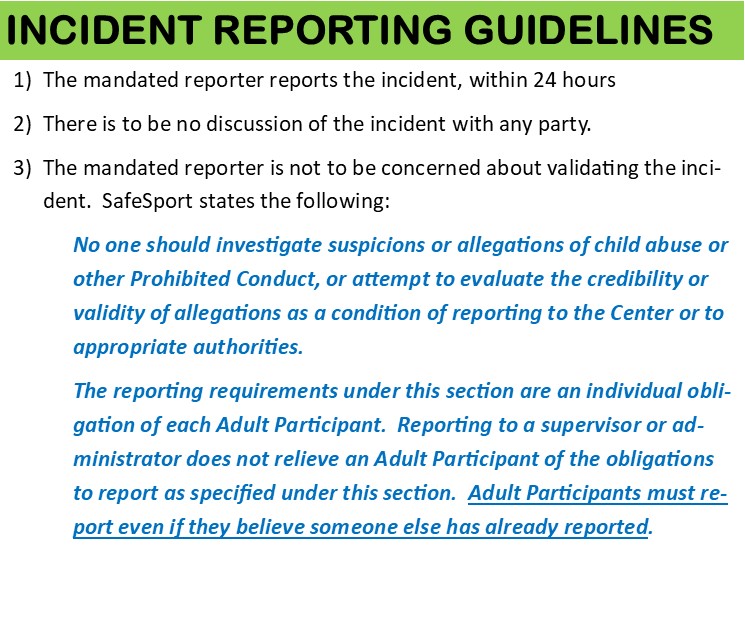
7. Established that an abuse incident must be reported within 24 hours after discovery.
NOTE:
Youth referees are covered by this law as well.

The major organizational types covered by this new law were distinguished as Olympics Sports Organizations, Paralympic Sports Organization, ‘Non-NGB‘ organizations, and ‘NGB‘ organizations. The term ‘NGB‘ standing for ‘National Governing Body‘. As ‘Paralympic Sports’/Olympic Sports do not apply to District VIII, this will not be discussed. The distinction between Non-NGB organizations and NGB organizations was defined by the manner in which play was conducted. Non-NGB organizations were defined as those that do not participate in interstate, or international competitions, while NGB organizations are those that do participate in interstate and international play.
For all leagues/clubs/associations within Cal North, District VIII, they belong to California Soccer Association North, which is a sanctioned member of the organization, U.S. Soccer, and USYS, who are NGB organizations. All requirements in the SafeSport Act, required for members of an NGB organization, are mandated for all District VIII leagues/clubs/associations.

COACHES, VOLUNTEERS, and PERSONNEL HIRED BY AN AFFILIATE
- By federal law, you are now a ‘mandatory reporter‘, just like school teachers, police officers, school nurses, etc. By law you are required to report any forms of abuse seen by you.
- By the federal law, you are required to take mandatory abuse training, before you can be with youth athletes. Contact the organization that you coach for, to find out about getting access to the SafeSport on-line Abuse Training course.
- Your electronic communications with a minor youth athlete is directly affected. You must adhere to the communication requirement, as directed by the SafeSport ‘Minor Athlete Preventative Abuse Policy‘.
- For any meetings, you may not be alone with a minor athlete player. Another adult must be present. All meetings must adhere to the meeting requirements as stated under the SafeSport ‘Minor Athlete Preventative Abuse Policy‘.
- Carpooling requirements exist, under the SafeSport ‘Minor Athlete Preventative Abuse Policy‘.
- When with an minor youth athelete, you must always be in an observable and interruptible distance from another adult. This is a key item, which basically states, for any situation, that any non-parent/guardian of a youth athlete should never be alone with a player, in any given situation, unless a parent has specifically given permission for this to happen (i.e. such as driving a player home from practice).
- For teams that travel and spend the night away from home, there are also traveling requirements listed in the SafeSport ‘Minor Athlete Preventative Abuse Policy‘, which you need to follow.
- Please note that youth players & youth referees are covered under the SafeSport Act. Under the mental abuse provision of the act, some coaches will find that they will have to tone down derisive commentary to either their youth athlete players, or a youth referee. Bear in mind that Cal North rules state that no disparaging commentary may be directed toward a youth player, only positive/encouraging commentary may be made. Commentary such as ‘move it, or I will take you off the field’ is disparaging and embarrassing to the youth athlete, and is not positive commentary.
A checklist for the mandatory items facing a coach: HERE
SOCCER ORGANIZATION
Under the SafeSport Act, all affiliates of an NGB are required to provide the following:
- “offer and provide consistent training to all adult members who are in regular contact with amateur athletes who are minors…” The training is to include the recognition of grooming techniques, and abuse recognition. There is no mandated training provider.
Covered Organizations shall, subject to parental consent, annually offer and give training to members who are minors regarding prevention and reporting of child abuse. Covered Organizations shall track:
1. A description of the training(s);
2. The date the training(s) was offered and given; and
3. A description of how the training(s) was offered and given.
- Creation of reasonable procedures to limit one-on-one interactions between an adult who is not the athlete’s parent/guardian, and an amateur athlete who is a minor, who is not in an observable and interruptible distance from another adult. This is to cover training sessions, all travel, locker room/changing room interactions, and electronic communications. All items are listed in the SafeSport ‘MINOR ATHLETE ABUSE PREVENTION POLICIES‘, which provide for specific mandatory organization policies.
- Organization must establish an internal mechanism for reporting abuse to it, which protects the reporter from any form of reprisal/backlash, incorporates/documents an identified mechanism for reporting, and safeguards the incident information.
- Mandates that all abuse incidents must be reported within 24 hours, to the following:
U.S. Center for Safe Sport:
https://safesport.org/report-a-concern
Reporting Line: 720-531-0340
U.S. Soccer integrity hotline:
https://www.ussoccer.com/integrity-hotline
Integrity Hotline: 312-528-7004
Local Police/Sheriff Dept.
ANY OTHER ORGANIZATION, AS REQUIRED BY YOUR NGB FOR REPORTING
- Must either develop and distribute to staff/coaches/parents, an organizational abuse policy (which includes the minimum policy items, as designated in the SafeSport ‘MINOR ATHLETE ABUSE PREVENTION POLICIES, January 23, 2019‘, or use that policy for their organization. An organization may develop sterner polices & procedures, but must have the mandatory/minimum polices & procedures incorporated, as stated in the ‘MINOR ATHLETE ABUSE PREVENTION POLICIES, January 23, 2019’, The self-created policy & procedures must be submitted to the U.S. Center for SafeSport, for review, as stated in the SafeSport . ‘MINOR ATHLETE ABUSE PREVENTION POLICIES, January 23, 2019‘.
- All parties, 18 & older, must complete the SafeSport training, before regular contact with an athlete who is a minor begins, or within the first 45 days of initial membership, or upon beginning a new role subjecting the adult to this policy. This training must be refreshed annually, by taking the appropriate SafeSport course.
NOTE:
All of the mandated provisions within the SafeSport Act also apply to youth referees. Referee assignors will need to follow the same mandated provisions for working with youth referees, as coaches have to do with youth athletes. Referee assignors must also take the abuse training course, as coaches are required to do, and are also mandated reporters.

The U.S. Center for SafeSport has created online youth training courses. These courses are for children of pre-school age, grades K-2, grades 3-5, and middle school and high school. It will include courses for children of pre-school age, grades K-2, grades 3-5, and middle school and high school. These free online training courses are designed as an introduction for minor athletes and their parents or other caregivers to understand the importance of positive, welcoming environments in sports, where misconduct like bullying or abuse is less likely to happen, and to know where to report abuse, should it occur.
Each course will be hosted on athletesafety.org and requires that a parent/legal guardian create an account to provide consent for their child to access the training. Once an account is created, parents can choose which course is best for their child based on their actual or developmental age. Each course will take less than 30 minutes to complete.

U.S. Center for SafesSport On-line Abuse Report
SafeSport Minor Athlete Abuse Prevention Policy (MAPP)
SafeSport Minor Athlete Abuse Prevention Policy (MAPP)- Implementation Guide
U.S. Center for Safe Sports – Parent Resources
Athlete Safety.org
Parent Toolkit
For Parents of High School Children
For Parents of Middle School Children
For Parents of School-Age Children
U.S. Center for SafeSports – PODCASTS
Trauma and Child Abuse Resource Center
National Children’s Advocacy Center
Insurance Company PODcast on SafeSport Law
Raliance Sport + Prevention Center
Futures Without Violence: Coaching Boys into Men
Harborview Center for Sexual Assault and Traumatic Stress: Athletes As Leaders
National Center for Missing & Exploited Children: KidSmartz and NetSmartz
Monique Burr Foundation: MBF Athlete Safety Matters
Stop It Now! Circles of Safety For Youth-Serving Organizations
All parents who have youth involved in athletic play need to read and understand the SafeSport Act rules, so that they can help protect their youth athlete. They need to understand the rules for:
- A coach being alone on the field with their player
- A coach having a meeting with their player
- A coach traveling with their player
- Overnight stays, in hotel facilities
- How solo meetings must be conducted
- How solo training must be conducted
- How their player can be contacted, through electronic media, and how the parent can regulate such contact
The parent must ensure that they do all in their power to help ensure that the rules are carried out, for items that are directly under their control. Some examples of these are;
- The parent does not just drop their player off at the curb, for practices, and just takes off. They get out and ensure that other players and adults are present at the practice site. This also applies to team meetings, especially if held inside, out of the public view.
- The parent is not habitually late picking their player up from practice sessions, which could potentially put their coach in a pickle, as everyone else has left, and they are left alone with their child. This is a bad spot for a coach, as they would be put in the position of asking someone else to stay, until the late parent arrived. This is an inconvenience to the party that might stay, and an inconvenience to the coach. It is the parents responsibility to be timely in picking their child up, and not trying to squeeze the last minute out of whatever activity that they are involved in, while practice is going on. The coach and others on the teams have lives also, and are eager to get on with their evening.
- If wanting the coach/team staff member, to give their child a ride home, that this must be accomplished by giving written permission for this to happen. A phone call does not cover this.
- If you have a question for the coach/team staff, and communicating through electronic media, try not to have your player send the message, do it yourself.
- Ensure that you have conveyed your feelings for the coach/team staff having individual communication contact with your player, using social media.
DISCLAIMER: THIS WEBSITE DOES NOT PROVIDE MEDICAL ADVICE
The information, including but not limited to, text, graphics, images and other material contained on this website are for informational purposes only. The purpose of this website is to promote understanding and knowledge of soccer and soccer health related matters. It is not intended to be a substitute for professional medical advice, diagnosis or treatment. Always seek the advice of your physician or other qualified health care provider with any questions you may have regarding a medical condition or treatment and before undertaking a new health care regimen, and never disregard professional medical advice or delay in seeking it because of something you have read on this website. Soccer information is related to players playing in Cal North/CYSA soccer organizations.
Copyright © 2018, Jack Smith, All rights reserved. Information contained within this site may not be reproduced on another site, or copied into other documents, in part, or whole.