
 There is much talk about effectiveness of headgear. Headgear manufacturers have paid for studies, which state the effectiveness of their headgear. Some medical professionals question some of the studies, as they did not go through medical peer review, and were solely independent tests for the headgear seller. On the scientific medical testing side, there is debate, back and forth over the actual benefit of wearing/not wearing headgear. Over the years there has been an increasing number of review/testing of headgear from independent organizations. A review in 2020 still confirmed the aspect of the questionable protection of soccer headgear.
One item that is universally accepted is that the wearing of soccer headgear will not prevent a player from sustaining a concussion.
Conflicting Research Results
There has been work, occurring over the years, which has been contradictory in nature. In 2008, McGill University, in Canada, produced a study that stated that headgear reduced the concussion potential of a player by 50%. The McGill study was later contradicted in 2010, by the American Academy of Pediatrics’ Council on Sports Medicine who stated that “data currently are insufficient to state that soft helmets prevent head injury, and this absence of prospective data, combined with a lack of uniform safety standards and regulations, makes universal support of soft helmets premature at this time.”. The following are some examples of previous research studies.
In 2007, researchers at Canada’s McGill University, studied a control group of 250 adolescent (ages 12 to 17) soccer players, for their 2006 playing season. Their study found that 53% of the group not wearing headgear suffered a concussion, compared to 27% of the players who did wear headgear. This study was released in July, of 2007.
A study by FIFA concluded that “…headgear has a negligible effect in head-to-ball impacts but does provide “measurable benefit” in sub-concussive head-to-head impacts.” US Youth Soccer issued heading guidelines, in May, 2013–here. USSF has also issued a statement regarding the wearing of headgear by players–here.
In August, 2017, Dr Alan Pearce, a leading concussion expert, from La Trobe University, said the problem was exacerbated by the fact headgear does not protect kids. “All the peer-reviewed scientific research has shown helmets don’t protect the brain from a concussion injury,” Dr Pearce said. “What helmets do is protect the head”.
US Youth Soccer On Headgear
In late 2015, US Youth Soccer (USYS) published a recommendation that stated that heading should not be allowed in players U12 and down. While this had been stated as a heading ‘ban’, it had no direct affect on the many soccer groups operating under USYS. USYS had stated that they had no authority to mandate the decision upon the groups. The ban was placed into effect on the two groups solely controlled by USYS, which had a very small set of soccer players (national team & development team).
In 2016, starting in January, the tide began to change as many organizations started implementing this as a operating policy for themselves, banning heading in age groups aged 12 and down.
NFHS And Headgear
The National Federation of State High School Associations (NFHS) has a written commentary on soft headgear here .
Virginia Tech Study In 2018
In April of 2018, Virginia Tech issued a study stating that soccer head gear could protect a players head, up to 84%, against concussions, and issued ratings for head gear that it had tested.
Virginia Tech study: Helmets drastically reduce soccer injuries
Virginia Tech Head Gear Ratings
In the wake of the Virginia Tech study, it can be expected that headgear manufacturers will quickly point to it as a qualified justification for their headgear. With the study having produced a headgear ratings chart, heavy discussions can be expected to develop, concerning soccer players and headgear.
SOME OTHER REVIEWS/COMMENTARIES
In 2019, research was done over a soccer season by the University of Wisconsin School of Medicine аnd Public Heаlth. The result of the test indicated that “soccer headgear didn’t reduce the overall number or severity of concussions experienced by high school players….”.
British Journal of Sports Medicine (BJSM) published the results of a randomized trial of headgear to reduce concussions in soccer players (May 14, 2019) Analyzed repot on the random trial; May, 2019
A paper produced by the British Journal of Sports Medicine, in 2020,
addressed, again, the question of the effectiveness of headgear in
soccer. This 2020 paper created commentary, such as the one here, regarding soccer headgear.
General Aspect of Headgear
The historical belief is that headgear, at its’ best, will only slightly reduce the amount of impact force that a head receives from an impact. Some studies have stated headgear reduces the impact force greater than historically believed. The VIrginia Tech Study, released in April, of 2018, stated that headgear reduces the impact force of a blow to the head up to 84%. Is any one form of headgear better than another? This has been historically unknown, as the headgear is a relatively new item, and like concussions in general, evaluations/testing is still in its’ infancy. The Virginia Tech study, of 2018, was the only study to produce a full rating chart for headgear, covering numerous headgear.
While debating the effectiveness of soccer headgear, there is something associated with the wearing of it that bothers researchers. There is a condition known as the ‘superman effect‘, in which a player that wears headgear may feel that they are invincible to head injuries. They may play more recklessly, and with more abandon than they previously did. This is totally counterproductive toward protecting them from concussions. Some research stories have contradicted this.
The player needs to be made fully aware that the headgear is only a mechanism to help reduce contusions, bruises, scrapes, and applied force from a hit from a player/ground. It will not prevent them from getting concussions.
Parents should be fully aware that headgear may help to reduce the force of an impact & contusions, the headgear will do nothing when a hit solely to the body of a player occurs. This hit brings rotational acceleration factors into play, which affect the brain. The headgear is useless in this form of hit, but may reduce contusion/force effects if the player falls to the ground after the initial hit to the body, hitting their head. This example is from a football game, where a player hits their head, hard, when landing on the ground. While the helmet protected the skull from getting cracked, it could not protect the brain. When the head hit the ground, the brain would have shot forward, hitting the front of the skull, and then rebounded, hitting the rear of the skull, that is the minimum. It could have also shot back forward, striking the front of the skull again. The player was basically knocked out, showing sign of the ‘fencing effect‘, with the arms being held up in the air.
Heading The Ball
There is speculation concerning the heading of balls, leading some to believe that headgear is the cure to this speculated problem. The concern on heading the ball is due to subconcussive hits, adding up over a period of time, to cause future health problems. There is no current scientific data to prove this, at this point in time, but there is much speculation. In April, of 2018, Albert Einstein College of Medicine of New York City, issued their results of a study on heading, with test subjects 18-55 years old. They found that heading was the major source of concussion related symptoms, over collisions.
The speculation may change, based on a 2017, Boston University study. The study found that 110 out of 111 tested brains, from deceased football players, showed signs of chronic traumatic encephalopathy (CTE). Ann McKee, from Boston University, stated “Soccer has repetitive impacts, from player to player and players heading the ball”. Ann McKee was involved in the research on the NFL brain study. She further stated “It doesn’t matter how you do it, just that you do it and do it repetitively.”
Most personnel in the research field believe that more emphasis needs to be directed on how to do headers properly. The belief is that some players may derive concussions from heading the ball improperly. There is a continuing debate on whether young players should be doing headers. National and local soccer organizations have created rules to further protect youth players, by avoiding headers in the younger age groups.
For female players, there is general agreement that due to their smaller neck size and associated neck/back muscles, that they should have strengthening exercises incorporated into their training. The theory is that heading the ball places more of a strain on the female player, potentially leading to concussion situations, simply due to the physical make-up of the female body (weaker neck muscles).
For leagues, they need to ensure that all coaches/assistant coaches in age groups where heading is performed, have the necessary training in heading, to pass on to their team.
Types Of Soccer Headgear
Soccer headgear comes in several different shapes. Below are some examples
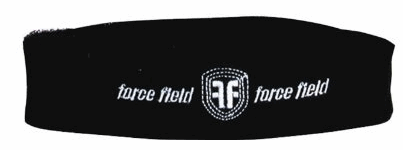
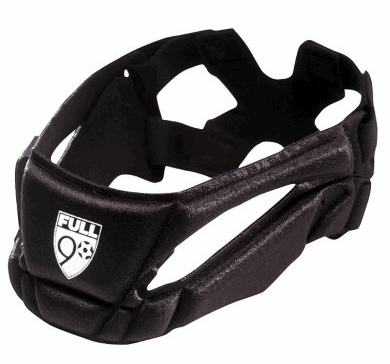
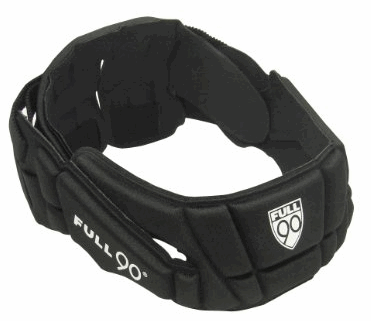
The above headgear is a form of the ‘standard’ form of headgear, which typically comes in different colors/prices.
The following headgear is offered by Full90, which is more of a rugby type helmet.
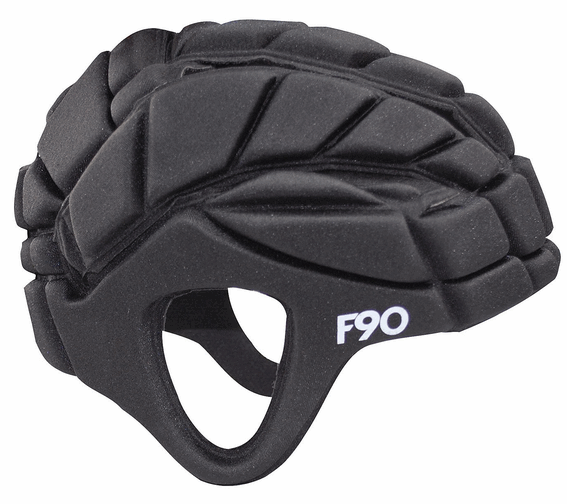

The ‘rugby’ type headgear, was adopted by a veteran, well-known, soccer goalie, Petr Cech, the former Chelsea goal keeper. He suffered a skull fracture during a match and began wearing a Cantebury, rugby playing helmet, which FIFA approved for usage.
This helmet is designed to protect the entire head, which Petr wanted. The helmet helped Petr during a second potentially dangerous incident. He now wears the helmet as a regular item.
Logan Pause, goalie for the Chicago Fire, sustained a concussion and returned to play using a rugby style helmet. There are also a limited number of professional soccer players, non-goalies, that are wearing the rugby type of helmet. In each case, they did so after having a concussion hit. Video of why Petr Cech wears a helmet: Here
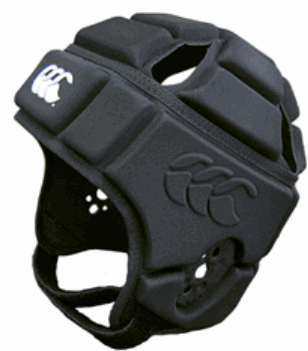
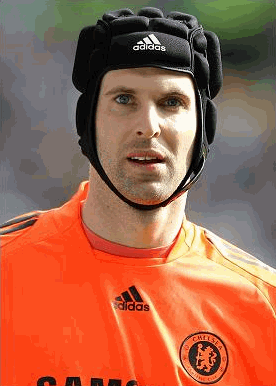
This is the rugby type helmet that former Chelsea goalie, Petr Cech, currently wears to play in games:
This rugby helmet affords full head protection to a goalie
(NOTE: The first helmet, the Canterbury helmet, is his original helmet. The helmet that he is shown wearing is the Adidas helmet. He started using this helmet due to ‘marketing issues’ with the Canterbury logo, versus Chelsea club affiliation requirements). Both helmets are accepted by FIFA.)
The Soccer Goalie & The Need For Head Protection
It should be especially noted that of all players on the field, the goalie is a party that should be strongly considered for wearing headgear, in all games. The goalie finds themselves in positions that the ordinary player does not. They may be constantly diving/challenging for the ball, leaving their head in vulnerable positions.
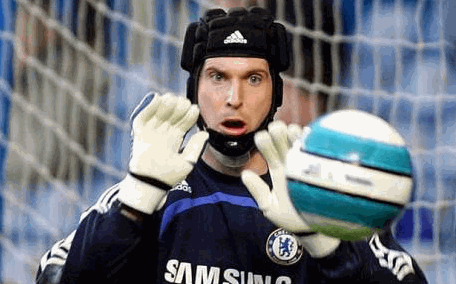 Diving for a ball in the goal area may result in the goalie going head first into a goal post. The ‘headband’ form of headgear would then not help, as the goalie may strike the post with the top of their head, which is not protected with the current soccer headgear. Only the rugby helmet offers that protection. The same applies when the goalie is on the ground, when they have dived for a ball. They are subject to being accidentally kicked in the head by a charging player. For over-all protection, the goalie may need a piece of headgear requiring more coverage, such as that given by the rugby type helmet.
There is one other item that a goalie has to deal with, that the majority of field players do not–The goal posts. For permanent goals, these may be big, and metal, with the standard rectangle edges. These edges, not to mention the metal post itself, can do damage to a goalie’s head, if they dive/run into it. In 99.99% of the cases, goal posts are not padded, and there has been no movement at getting the goals padded, to protect the goalie. Only a rugby type helmet, with 360 degree padding/top padding, would provide more assurance of total head protection, in the event of a goal post collision. A ‘headband’ type headgear would not help, in a top of the head hit to a goal post.
To further understand why a goalie needs to be fully protected, take a look at the following picture, which I took at a U10 girls game.
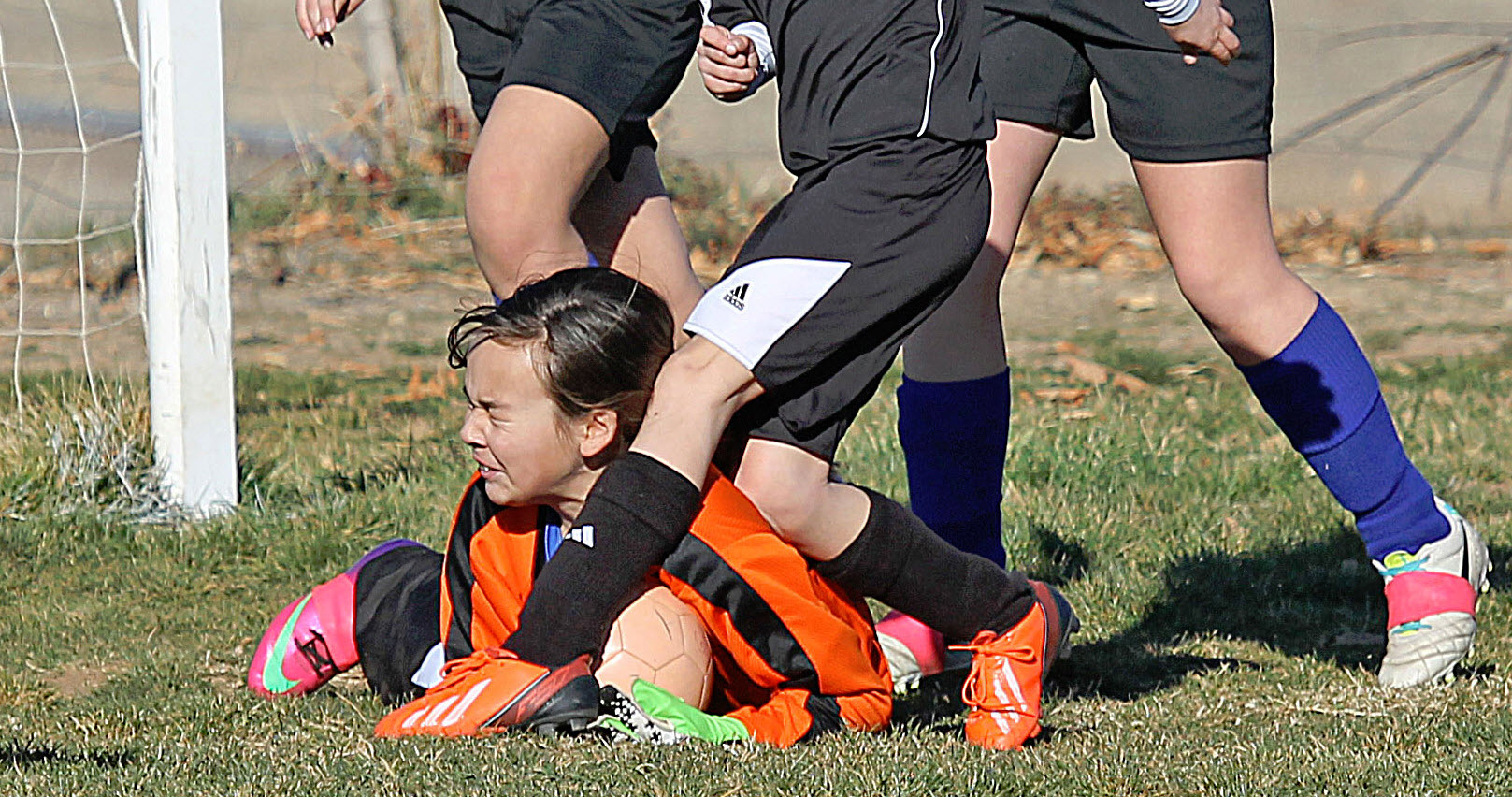
This goalie took a knee to the back, from right leg, and a knee to the head, from the left leg. If you look to where the left foot of the player landed, the goalie was lucky that she did not get her hand stepped on at the same time.
This is the expression on the goalie’s face, eyes squeezed tight, and a pained grimace on her face. This was absolutely not a pleasant experience.

In this one play by the goalkeeper, of many plays that can happen in a game, the head, and back were impacted, with their hand almost stepped on.
The Social Dynamics of Headgear
The real challenge to headgear may be in getting a player to wear it. Players may see wearing the headgear as a sign of ‘weakness’, or as a ‘social problem’. For boys, it is a greater issue, as it then gets tangled into ego. It does not end here. The thoughts of parents come into play on this issue also, but may have nothing to do with safety. If a parent believes that wearing headgear makes their player’s playing image to look ‘weak’, they will not support headgear.
Before introducing the headgear as a wearing apparatus, the player should be educated on concussions, and on what it could mean to their future, or lack thereof. They should also be made fully aware of what the headgear can and cannot do (i.e., does not make them invincible). Video presentations, especially those that depict players and the consequences of concussions for them, may be beneficial. Some soccer programs are including headgear as a required part of the soccer gear.
If headgear is used by a program, they should discuss with their players the reality of what headgear means, and does not mean. Wearing headgear must not lead to the player believing that they can play with abandon.
Headgear, To Be, or Not To Be?
There is plenty of commentary on one side of the scale, stating that headgear does not prevent concussions. With the 2018 – Virgina Tech study, there is more information on the opposite side of the scale in favor of headgear. Is one study a conclusive indicator? That is for individual consideration by the reader/evaluator.
What can be stated about headgear, which most all would universally accept, is that headgear will help prevent contusions/bruises/scrapes to the head, if the incident includes the headband area (i.e. hits to the head, knee to the head, ground scraping, etc.), and may reduce some force of the impact.
For the goalkeeper, heavier consideration for the mandatory wearing of headgear may want to be considered, due to the nature of the position that they play, and the close proximity of goal posts.
For parties concerned about heads bashing together, there was a safety valve put into place by US Soccer, by banning heading in the age groups U11 and down. Heading in soccer is where the majority of head knocking happened. For the concern regarding the weak neck muscles of girls, which come into play when doing headers, the issue is moot for U11 and down players, as they do no headers, under US Soccer rules. For Cal North, their rules state no heading for players U12 and down. Some others have rules stating no heading for U14 and down.
The overall threat of being hit in the head is not totally eliminated by not doing heading. A player can still be kicked in the head by a high kick, hit in the head by a kicked ball, or hit by a high swinging arm. The goalkeeper is the party that has more potential for their head to be involved in a physical involvement, due to the nature of their job.
For the protection of a child, safety would always be the higher consideration. Any safety policy/practice, requiring the usage of headgear, should always be well published to prospective players, at all player registrations, so that parents are aware. This gives them the opportunity to either accept the item and register, or reject the item by not signing up. This also alerts the parent that there is an extra cost to play (i.e. buying headgear), for their player to be eligible to play.
The following videos are meant to inform, not provide judgment
Some Sites That Carry Rugby Type Helmets
Worldrugbyshop (Pricey; Amazon has better prices)
Amazon
Amazon
Amazon (UK)
Canterbury
Adidas Rugby Helmet
Pro-directrugby
Keeperstop
DISCLAIMER: THIS WEBSITE DOES NOT PROVIDE MEDICAL ADVICE
The information, including but not limited to, text, graphics, images and other material contained on this website are for informational purposes only. The purpose of this website is to promote understanding and knowledge of soccer and soccer health related matters. It is not intended to be a substitute for professional medical advice, diagnosis or treatment. Always seek the advice of your physician or other qualified health care provider with any questions you may have regarding a medical condition or treatment and before undertaking a new health care regimen, and never disregard professional medical advice or delay in seeking it because of something you have read on this website.
Copyright © 2014, Jack Smith, All rights reserved. Information contained within this site may not be reproduced on another site, or copied into other documents, in part, or whole.
Virginia Tech Study In 2018
In April of 2018, Virginia Tech issued a study stating that soccer head gear could protect a players head, up to 84%, against concussions, and issued ratings for head gear that it had tested.
Virginia Tech study: Helmets drastically reduce soccer injuries
Virginia Tech Head Gear Ratings
British Journal of Sports Medicine (BJSM) published the results of a randomized trial of headgear to reduce concussions in soccer players (May 14, 2019)
Analyzed repot on the random trial; May, 2019
In the wake of the Virginia Tech study, it can be expected that headgear manufacturers will quickly point to it as a qualified justification for their headgear. With the study having produced a headgear ratings chart, heavy discussions can be expected to develop, concerning soccer players and headgear.
SOME OTHER REVIEWS/COMMENTARIES
A paper produced by the British Journal of Sports Medicine, in 2020,
addressed, again, the question of the effectiveness of headgear in
soccer. This 2020 paper created commentary, such as the one here,
regarding soccer headgear.
General Aspect of Headgear
The historical belief is that headgear, at its’ best, will only slightly reduce the amount of impact force that a head receives from an impact. Some studies have stated headgear reduces the impact force greater than historically believed. The VIrginia Tech Study, released in April, of 2018, stated that headgear reduces the impact force of a blow to the head up to 84%. Is any one form of headgear better than another? This has been historically unknown, as the headgear is a relatively new item, and like concussions in general, evaluations/testing is still in its’ infancy. The Virginia Tech study, of 2018, was the only study to produce a full rating chart for headgear, covering numerous headgear.
While debating the effectiveness of soccer headgear, there is something associated with the wearing of it that bothers researchers. There is a condition known as the ‘superman effect‘, in which a player that wears headgear may feel that they are invincible to head injuries. They may play more recklessly, and with more abandon than they previously did. This is totally counterproductive toward protecting them from concussions. Some research stories have contradicted this.
The player needs to be made fully aware that the headgear is only a mechanism to help reduce contusions, bruises, scrapes, and applied force from a hit from a player/ground. It will not prevent them from getting concussions.
Parents should be fully aware that headgear may help to reduce the force of an impact & contusions, the headgear will do nothing when a hit solely to the body of a player occurs. This hit brings rotational acceleration factors into play, which affect the brain. The headgear is useless in this form of hit, but may reduce contusion/force effects if the player falls to the ground after the initial hit to the body, hitting their head. This example is from a football game, where a player hits their head, hard, when landing on the ground. While the helmet protected the skull from getting cracked, it could not protect the brain. When the head hit the ground, the brain would have shot forward, hitting the front of the skull, and then rebounded, hitting the rear of the skull, that is the minimum. It could have also shot back forward, striking the front of the skull again. The player was basically knocked out, showing sign of the ‘fencing effect‘, with the arms being held up in the air.
Heading The Ball
There is speculation concerning the heading of balls, leading some to believe that headgear is the cure to this speculated problem. The concern on heading the ball is due to subconcussive hits, adding up over a period of time, to cause future health problems. There is no current scientific data to prove this, at this point in time, but there is much speculation. In April, of 2018, Albert Einstein College of Medicine of New York City, issued their results of a study on heading, with test subjects 18-55 years old. They found that heading was the major source of concussion related symptoms, over collisions.
The speculation may change, based on a 2017, Boston University study. The study found that 110 out of 111 tested brains, from deceased football players, showed signs of chronic traumatic encephalopathy (CTE). Ann McKee, from Boston University, stated “Soccer has repetitive impacts, from player to player and players heading the ball”. Ann McKee was involved in the research on the NFL brain study. She further stated “It doesn’t matter how you do it, just that you do it and do it repetitively.”
Most personnel in the research field believe that more emphasis needs to be directed on how to do headers properly. The belief is that some players may derive concussions from heading the ball improperly. There is a continuing debate on whether young players should be doing headers. National and local soccer organizations have created rules to further protect youth players, by avoiding headers in the younger age groups.
For female players, there is general agreement that due to their smaller neck size and associated neck/back muscles, that they should have strengthening exercises incorporated into their training. The theory is that heading the ball places more of a strain on the female player, potentially leading to concussion situations, simply due to the physical make-up of the female body (weaker neck muscles).
For leagues, they need to ensure that all coaches/assistant coaches in age groups where heading is performed, have the necessary training in heading, to pass on to their team.
Types Of Soccer Headgear
Soccer headgear comes in several different shapes. Below are some examples
The above headgear is a form of the ‘standard’ form of headgear, which typically comes in different colors/prices.
The following headgear is offered by Full90, which is more of a rugby type helmet.
The ‘rugby’ type headgear, was adopted by a veteran, well-known, soccer goalie, Petr Cech, the former Chelsea goal keeper. He suffered a skull fracture during a match and began wearing a Cantebury, rugby playing helmet, which FIFA approved for usage.
This helmet is designed to protect the entire head, which Petr wanted. The helmet helped Petr during a second potentially dangerous incident. He now wears the helmet as a regular item.
Logan Pause, goalie for the Chicago Fire, sustained a concussion and returned to play using a rugby style helmet. There are also a limited number of professional soccer players, non-goalies, that are wearing the rugby type of helmet. In each case, they did so after having a concussion hit. Video of why Petr Cech wears a helmet: Here
This is the rugby type helmet that former Chelsea goalie, Petr Cech, currently wears to play in games:
This rugby helmet affords full head protection to a goalie
(NOTE: The first helmet, the Canterbury helmet, is his original helmet. The helmet that he is shown wearing is the Adidas helmet. He started using this helmet due to ‘marketing issues’ with the Canterbury logo, versus Chelsea club affiliation requirements). Both helmets are accepted by FIFA.)
The Soccer Goalie & The Need For Head Protection
It should be especially noted that of all players on the field, the goalie is a party that should be strongly considered for wearing headgear, in all games. The goalie finds themselves in positions that the ordinary player does not. They may be constantly diving/challenging for the ball, leaving their head in vulnerable positions.
https://youtu.be/G7gJTOwWBkI
Diving for a ball in the goal area may result in the goalie going head first into a goal post. The ‘headband’ form of headgear would then not help, as the goalie may strike the post with the top of their head, which is not protected with the current soccer headgear. Only the rugby helmet offers that protection. The same applies when the goalie is on the ground, when they have dived for a ball. They are subject to being accidentally kicked in the head by a charging player. For over-all protection, the goalie may need a piece of headgear requiring more coverage, such as that given by the rugby type helmet. There is one other item that a goalie has to deal with, that the majority of field players do not–The goal posts. For permanent goals, these may be big, and metal, with the standard rectangle edges. These edges, not to mention the metal post itself, can do damage to a goalie’s head, if they dive/run into it. In 99.99% of the cases, goal posts are not padded, and there has been no movement at getting the goals padded, to protect the goalie. Only a rugby type helmet, with 360 degree padding/top padding, would provide more assurance of total head protection, in the event of a goal post collision. A ‘headband’ type headgear would not help, in a top of the head hit to a goal post.
To further understand why a goalie needs to be fully protected, take a look at the following picture, which I took at a U10 girls game.
This goalie took a knee to the back, from right leg, and a knee to the head, from the left leg. If you look to where the left foot of the player landed, the goalie was lucky that she did not get her hand stepped on at the same time.
This is the expression on the goalie’s face, eyes squeezed tight, and a pained grimace on her face. This was absolutely not a pleasant experience.
In this one play by the goalkeeper, of many plays that can happen in a game, the head, and back were impacted, with their hand almost stepped on.
The Social Dynamics of Headgear
The real challenge to headgear may be in getting a player to wear it. Players may see wearing the headgear as a sign of ‘weakness’, or as a ‘social problem’. For boys, it is a greater issue, as it then gets tangled into ego. It does not end here. The thoughts of parents come into play on this issue also, but may have nothing to do with safety. If a parent believes that wearing headgear makes their player’s playing image to look ‘weak’, they will not support headgear.
Before introducing the headgear as a wearing apparatus, the player should be educated on concussions, and on what it could mean to their future, or lack thereof. They should also be made fully aware of what the headgear can and cannot do (i.e., does not make them invincible). Video presentations, especially those that depict players and the consequences of concussions for them, may be beneficial. Some soccer programs are including headgear as a required part of the soccer gear.
If headgear is used by a program, they should discuss with their players the reality of what headgear means, and does not mean. Wearing headgear must not lead to the player believing that they can play with abandon.
Headgear, To Be, or Not To Be?
There is plenty of commentary on one side of the scale, stating that headgear does not prevent concussions. With the 2018 – Virgina Tech study, there is more information on the opposite side of the scale in favor of headgear. Is one study a conclusive indicator? That is for individual consideration by the reader/evaluator.
What can be stated about headgear, which most all would universally accept, is that headgear will help prevent contusions/bruises/scrapes to the head, if the incident includes the headband area (i.e. hits to the head, knee to the head, ground scraping, etc.), and may reduce some force of the impact.
For the goalkeeper, heavier consideration for the mandatory wearing of headgear may want to be considered, due to the nature of the position that they play, and the close proximity of goal posts.
For parties concerned about heads bashing together, there was a safety valve put into place by US Soccer, by banning heading in the age groups U11 and down. Heading in soccer is where the majority of head knocking happened. For the concern regarding the weak neck muscles of girls, which come into play when doing headers, the issue is moot for U11 and down players, as they do no headers, under US Soccer rules. For Cal North, their rules state no heading for players U12 and down. Some others have rules stating no heading for U14 and down.
The overall threat of being hit in the head is not totally eliminated by not doing heading. A player can still be kicked in the head by a high kick, hit in the head by a kicked ball, or hit by a high swinging arm. The goalkeeper is the party that has more potential for their head to be involved in a physical involvement, due to the nature of their job.
For the protection of a child, safety would always be the higher consideration. Any safety policy/practice, requiring the usage of headgear, should always be well published to prospective players, at all player registrations, so that parents are aware. This gives them the opportunity to either accept the item and register, or reject the item by not signing up. This also alerts the parent that there is an extra cost to play (i.e. buying headgear), for their player to be eligible to play.
The following videos are meant to inform, not provide judgment
Some Sites That Carry Rugby Type Helmets
Worldrugbyshop (Pricey; Amazon has better prices)
Amazon
Amazon
Amazon (UK)
Canterbury
Adidas Rugby Helmet
Pro-directrugby
Keeperstop
DISCLAIMER: THIS WEBSITE DOES NOT PROVIDE MEDICAL ADVICE
The information, including but not limited to, text, graphics, images and other material contained on this website are for informational purposes only. The purpose of this website is to promote understanding and knowledge of soccer and soccer health related matters. It is not intended to be a substitute for professional medical advice, diagnosis or treatment. Always seek the advice of your physician or other qualified health care provider with any questions you may have regarding a medical condition or treatment and before undertaking a new health care regimen, and never disregard professional medical advice or delay in seeking it because of something you have read on this website.
Copyright © 2014, Jack Smith, All rights reserved. Information contained within this site may not be reproduced on another site, or copied into other documents, in part, or whole.