
The coach has the responsibility of insuring that the health and welfare of their players is maintained, at all times. They must be fully aware of the protocols/procedures that are in place for concussions from the league/group/club that they play under. They are inherently liable for insuring that they adhere to those conditions of play. This protects the health of the players and shields the coach from any condition of liability, should a player get injured from a concussion.
Many states have passed concussion laws which require a coach to have concussion training, and to yearly update their concussion knowledge. In California, on January 1, 2017, a state law was enacted thru AB 2007. This law requires virtually all non-school related sports groups to ensure that coaches take concussion training, before they take over a team. This same law requires parents and athletes to sign a concussion acknowledgement form, yearly, which gives them concussion information. The general theme is to insure that all parties have the proper information on concussions.
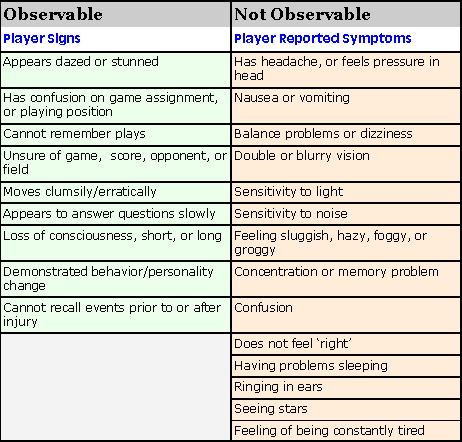
The coach needs to insure that they are aware of concussion signs/symptoms, and be prepared to evaluate a player at practices/games. A coach might consider establishing a procedure within their team for handling concussions, with designated team officials having defined duties. This would help the coach in the event that they were not present for a game/practice. These parties would have to be versed in concussions, and any established rules/procedures specified by their playing league/group/club.
A coach should cover the following topics, to ensure that they are prepared to handle a concussion situation:
Concussion signs & symptoms
Understand what significance second impact syndrome plays
Recognize a ‘fencing response‘.
Have developed a mechanism for evaluating a player, during a game, or practice. This could be from using a concussion evaluating tool, or through a method provided by the league/group. Coaches sometimes get thoroughly keyed into play on the field during a game. A coach could develop a system that has the assistant coach do evaluation of a suspected concussed player, while the coach continues to concentrate on the game. When the assistant coach has completed the evaluation, they both can discuss the results, with the parents.
The parents should also understand that under the rules of most sports groups, and California State Law, once a player has been removed from play due to a suspected concussion, they may not return to play until they have been examined by a doctor/athletic trainer, who is qualified in concussions.
This evaluation is simply to ensure that the player is not exhibiting critical signs of a concussion, which would require immediate transport to a medical facility. A coach is not expected to ‘play doctor’. The parent must see that their player receives proper medical examination, from a qualified medical doctor/Athletic Trainer.
The coach needs to ensure that their assistant coach is educated in concussions, in the same manner that they are. A coach may be absent for a game/practice, and the assistant coach would be expected to handle any potential concussion issue, as the coach would.
Refresh themselves yearly on concussion signs & symptoms, by taking a concussion test. This training is available for free from the Center for Disease Control (CDC), or their league/group may offer something.
Have up-to-date contact information for the parents, so they can be reached immediately, if not at practice/game
Have held a team meeting, discussing concussions with the players and parents. The coach should ensure that players/parents understand that you, the coach, values player safety first, with the game being second. Players should be encouraged to immediately tell you, if they do not feel ‘right’, after a collision with a player/ground/ball. If parents are not ‘concussion aware’, the coach can point out concussion resources, such as at the CDC website.
Understand what a ‘return to play‘ program typically involves for a previously concussed player. They must be eased back into play slowly, following guidelines specified by their doctor, or the league/group the athlete belongs to.
The following shows situations where a coach/referee needs to make an immediate decision. What would you do?
What should a coach NOT do, if a youth player is suspected of having a concussion
 A coach should not indicate through body expressions that they are upset that the player is not in the game. They should not vocally indicate to anyone on the sideline that they ‘need/could use’ the player back in the game, or that there is now a ‘problem’ playing
Youth players are heavily influenced by their coaches, and they don’t want to disappoint them, or feel that they are letting the team down. In rare instances, they may feel that their ability to play on the team might be jeopardized if they stay out of the game. The player may not tell the coach exactly how they are feeling, if they are thinking any of those items
If sitting out, ‘under watch’, they may state that they are feeling o.k., when they are really not, just to get back into play. The coach needs to insure that they have an atmosphere where a youth player feels comfortable about telling their coach exactly how they feel.
This is an item that a coach should emphasize during the season, for practices, and for games. This is an item that should be discussed with the team before the first practice takes place. The youth player should understand that is it o.k. to tell about items that may be affecting their health on the field, and ability to play.
The coach plays a key part in creating and encouraging this atmosphere. The player should be aware that it is o.k. to sit the game out, if there is potential that they may have suffered a concussion. The ‘Coaches Guide to Concussions‘ can help a coach sort things out.
A coach should fully understand that for the vast majority of situations, for youth, the general principal is that if a concussion is suspected (‘when in doubt, sit them out‘), the player cannot be returned to play. It does not matter what the score is, the ‘importance’ of the game, the player’s stature as a ‘key’ player, or the players wishes, the only factor is the safety of the player’s health–period. If it is perceived that the coach ignored the safety procedures, putting the player potentially ‘at risk’, they could have liability issues, if the player’s health is affected.

DISCLAIMER: THIS WEBSITE DOES NOT PROVIDE MEDICAL ADVICE
The information, including but not limited to, text, graphics, images and other material contained on this website are for informational purposes only. The purpose of this website is to promote understanding and knowledge of soccer and soccer health related matters. It is not intended to be a substitute for professional medical advice, diagnosis or treatment. Always seek the advice of your physician or other qualified health care provider with any questions you may have regarding a medical condition or treatment and before undertaking a new health care regimen, and never disregard professional medical advice or delay in seeking it because of something you have read on this website.
Copyright © 2014, Jack Smith, All rights reserved. Information contained within this site may not be reproduced on another site, or copied into other documents, in part, or whole.