
The sport of soccer has a common problem that exists with many contact sports, the risk of concussions. This nationwide problem was recognized by US Youth Soccer in 2011. US Youth Soccer took steps to partner with the Center For Disease Control, in placing CDC information on concussions on their website. Concussions may happen and knowing how to handle it can help a player to enjoy a good sport, while also protecting their future ability to play and have a healthy life. Being aware of concussions symptoms/signs can help an athlete avoid complications of concussions that can affect their ability to play and live a daily life. A concussion is a Traumatic Brain Injury (TBI) to a part of the brain.
Concussions may happen and knowing how to handle it can help a player to enjoy a good sport, while also protecting their future ability to play and have a healthy life. Being aware of concussions symptoms/signs can help an athlete avoid complications of concussions that can affect their ability to play and live a daily life.
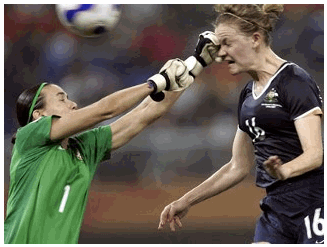 Concussions were once a relatively unknown factor for soccer coaches, but the topic has slowly surfaced, and is a highly relevant issue. Historically, there had not been much correlation between concussions and the playing of soccer. This does not mean that concussions have not existed in soccer, it just simply means that concussions may have not been diagnosed, or handled properly based on incomplete/false assumptions and attitudes, and soccer was not viewed as a ‘contact sport’, such as football.
Leagues for the most part may not have provided information to coaches, parents, or themselves, for learning how to identify and properly handle a player with a concussion, as the information was not easily available in the past, and was simply not thought of. All of this has now changed. There is now plenty of information and discussions revolving around concussions, and many fingers pointing at soccer, for a variety of reasons.
Heading in soccer has been pin-pointed as a potential issue for youth players, with many recommendations against under 14 yr. old players doing headers. Studies have began to tie heading into symptoms of ‘CTE’ (Chronic Traumatic Encephalopathy), which has also been found in the brains of football players.
There is another aspect of soccer that continuing reports/studies point out, female soccer players have a much higher incident of concussions than males in soccer. There are corresponding reports that indicate that female player fail to report their concussions, more than their male counterparts.
It has been determined by many studies that girls neck muscles are weaker than boys. To help girls alleviate concussion possibilities, there is an overall recommendation that there should be a neck strengthening program for female athletes.
In the past, MRI & CT scans did not reveal a concussion. The rsfMRI scan has been in use of the past years, with meaningful results.
Another new scanning method, the DTI (Diffusion Tensor Imaging) scan
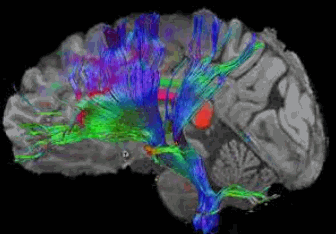
started to appear. There has been continuing research to determine the effectiveness of DTI scans. The DTI scan can detect sub-concussive brain damage as well as concussion damage. Both of these scans can help assess the damage to an athletes brain and help manage their recovery path. In June, 2016, researchers at Albert Einstein College of Medicine and Montefiore Health System, were able to make concussion predictions, using the DTI scan.
These electronic tools are helping to research/diagnose/treat individuals with concussions, or suspected concussions. If you have a player with a concussion/suspected concussion, you might check with your medical provider as to availability. This is not currently a standard item in a medical facility.
Anyone that has not heard the clamor regarding concussions, and heading the ball, must have their heads buried deeply in the sand. This is a topic that is discussed in the news routinely, and with state officials playing active roles in concussion awareness.
The focus on concussions was brought to the attention of the public through many stories surfacing from the NFL, regarding concussions to football players, and related corresponding research. This has led to increasing awareness and protective measures applied to protect players of the National Football League (NFL). This has caused a spill over into other sports activities. Soccer is now ranked as one of the top sports for potential concussions, especially for female athletes.
The reason for increased awareness and discussion of concussions is based on the medical communities increased focus on concussions, which began in the mid-2000’s. There has been a widespread collection of statistics, and individual victims commentaries that have been documented, in increasing numbers.
What has become of concern is what is happening to youths playing sports. It has been documented that a youth player is at a higher risk when a concussion occurs. The age-old statement that a youth player will ‘grow out of it’ does not apply to concussions. A developing youth brain is more susceptible to future impaired brain functions, if a concussion is not handled properly. A concussion can hinder the normal development of a youth brain. This brain continues to develop until it matures, generally at the age of 24.
The studies that have taken place are covering areas which previously were not researched, hence the information database is slowly being created. In some aspects of the research, such as that in the area of CTE, there has been much surprise on the results, and the general trend of the findings. There is growing discomfort over some of the findings, as they relate to youth players.
The studies are covering topics which previously were undiscovered, which had not given cause for concern. Times have changed, the information is being researched and debated openly in society, all the way to Washington, D.C.
In 2014, the President had a White House conference on discussions, and the U.S. Senate has held hearings, hearing testimony from players/physicians/sports personnel on concussion issues.
There has also been movement in various state legislative bodies to pass laws regarding concussions (California has passed AB 25, & AB 2127, which are aimed directly at high schools and high school coaches. Some sports organizations have instituted concussions policies of their own. For information on the California concussion laws click here.
In California, on January 1, 2017, a state law was enacted thru AB 2007. This law requires virtually all non-school related sports groups to ensure that coaches take concussion training, before they take over a team. This same law requires parents and athletes to sign a concussion acknowledgement form, yearly, which gives them concussion information.
Unfortunately, the vast majority of youth players play in non-school related sports programs. There has been no collective action by states, or cities, to address concussions for non-high school sports. While cities typically have some form of recreational youth sports programs, there has been no visible indication that these programs have concussion policies/procedures for the teams they put on fields.
Cities and schools control the fields that most sports programs use. A policy could be developed that required any group seeking to use the fields, to provide proof that they have a concussion program operating within their organization.
The vast majority of soccer coaches, parents, and soccer league administrators grew up during a time period when the general thought was ‘play on’. Getting your ‘bell rung‘, or getting ‘knocked silly’, were just acronyms which acknowledged the hit, with little understanding of what the hit could mean to the player’s health. In addition to this atmosphere, players were given the impression that not playing due to an injury was frowned upon. The team ‘needed you’, and unless you could not stand, walk, or run, you could play. The current medical knowledge on concussions is in total contrast to this. The theme now is ‘when in doubt, sit them out‘.
For a parent/coach, who played sports ‘in the day’, this can be a challenging item to deal with. Their past playing experience, and the past attitude towards injuries, may cloud their judgment on handling a concussion situation. They may not want their son/daughter to appear ‘weak’, be called a ‘sissy’, or worst, may be afraid of losing a spot on the team, or playing time.
This same frame of thought applies to the youth players, who do not want to ‘disappoint’ their coach/parent/team. All parties must be educated on concussions. What can be worst is a coach with a mind-set of a military drill instructor, who expects any member of their team to ‘tough it out’. This is not conducive to the health and well-being of a player, in a concussion situation.
All parties must come to the realization that the protection of the players health, and their future life, is way more important than the outcome of any particular game, or a player just playing in a game, on any particular day.
In January, 2014, news reports surfaced stating that some schools may consider dropping sports programs where the concussion liability risk is high.
No sports group can literally afford to ignore the issues surrounding concussions and player safety. A parent should be well aware of how concussions are handled in their players sport organization.
Concussions came to the forefront in the 2014 World Cup. There were multiple cases of players in demonstrated concussion situations, which were not handled properly, per FIFA’s own rules. The evidence presented to viewers around the world was clear and unmistakable, the players had an impairment. The players were allowed to continue playing.
The soccer world, including the professional players union for the soccer players, immediately became incensed. Sports commentators wrote articles questioning as to how FIFA could allow its’ own rule on concussions to be totally disregarded in a world viewed event. Many were concerned as to what type of image this presented to younger soccer players, for their handling of any concussion situation that they may be presented with.
A positive item that did emerge from watching the mishandling of concussions in the 2014 World Cup was an increased dialog and concentration on new mechanisms to protect players. This included a heightened realization that players must be protected from themselves, when they are in a precarious position of having a concussion and not thinking clearly.
On August 27, 2014, a lawsuit was filed against FIFA (see lawsuit here), which also included American soccer organizations. These American organizations included U.S. Soccer, American Youth Soccer (AYSO), National Association of Competitive Soccer Clubs, and Cal North/CYSA soccer.
This lawsuit alleged that all of the organizations had been negligent in the monitoring and treatment of head injuries. For the U.S. organizations, the suit sought to change the age at which heading the ball is allowed. The goal was to ban heading for players under 17 years of age. All organizations were given 60 days to respond to the lawsuit.
The lawsuit requested that FIFA allow players to be substituted to undergo a medical sideline evaluation for a concussion, in professional matches. There was also a request that medical supervision be available at fields for play & practice, for all organizations.
The driving force behind the lawsuit was concern over subconcussive hits/physical damages inflicted upon younger players, who are deemed to be too young for heading the ball, and a lack of procedural policies for handling concussions within the organizations. This lawsuit was rejected by the courts.
In response to the ‘Mehr‘, youth soccer concussion litigation, filed against soccer organizations, US Soccer issued a ‘Resolution To Concussion Litigation‘ .
In the Women’s 2015 World Cup, FIFA proved that like in the previous men’s World Cup, they still could not handle potential concussion situations. In a brutal collision between a German & US player, they made a mockery out of ‘when in doubt, sit them out’. Both players were on the ground for a while ( WWC Assessing Concussions ), with one player showing an obvious head wound with bleeding, which had discolored her hair. She is finally shown getting up and proceeding to rinse the blood out of her hair.
The final tally was that both players came back into the game, setting another extremely bad example for coaches & players around the world. In the Men’s World Cup, in 2018, the concussion fiasco for FIFA continued, with visible disregard for player safety.
In 2015, US Soccer issued a Concussion Initiative, which bans heading in U11 age groups and below. Included in this initiative was a direct statement to the referee. A referee is to terminate the game if the coach, or parent, disputes a player removed from the game, due to a suspected concussion incident. The player may not return to the game unless cleared by a certified medical professional, or a licensed athletic trainer.
This initiative is in effect for all organizations affiliated with US Soccer. The Cal North organization, in Northern California, does not allow heading in U12 and down age groups.
DISCLAIMER: THIS WEBSITE DOES NOT PROVIDE MEDICAL ADVICE
The information, including but not limited to, text, graphics, images and other material contained on this website are for informational purposes only. The purpose of this website is to promote understanding and knowledge of soccer and soccer health related matters. It is not intended to be a substitute for professional medical advice, diagnosis or treatment. Always seek the advice of your physician or other qualified health care provider with any questions you may have regarding a medical condition or treatment and before undertaking a new health care regimen, and never disregard professional medical advice or delay in seeking it because of something you have read on this website. Soccer information is related to players playing in Cal North/CYSA soccer organizations.
Copyright © 2014, Jack Smith, All rights reserved. Information contained within this site may not be reproduced on another site, or copied into other documents, in part, or whole.